

Lawsuit Lending and Fraud
The intersection of third-party litigation funding and fraud in New York raises important questions about transparency, financial incentives, and accountability in the civil justice system.
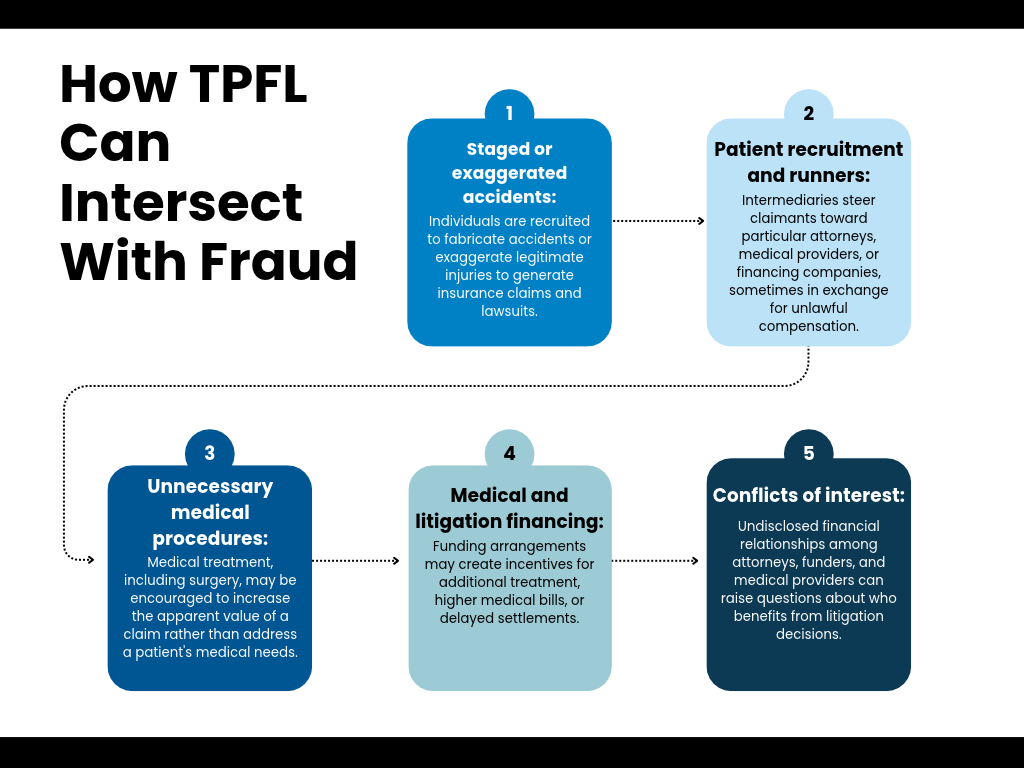
Documented prosecutions and ongoing civil litigation demonstrate that organized fraud can involve coordinated relationships among recruiters, attorneys, medical providers, and financiers. While legitimate litigation funding can improve access to justice, undisclosed or improper financial relationships may facilitate abuse.
Fraudulent litigation and improper funding arrangements can impose costs on insurers, employers, businesses, municipalities, and individuals. They may also harm legitimate injured claimants through unnecessary medical treatment or financing obligations that substantially reduce their recoveries.
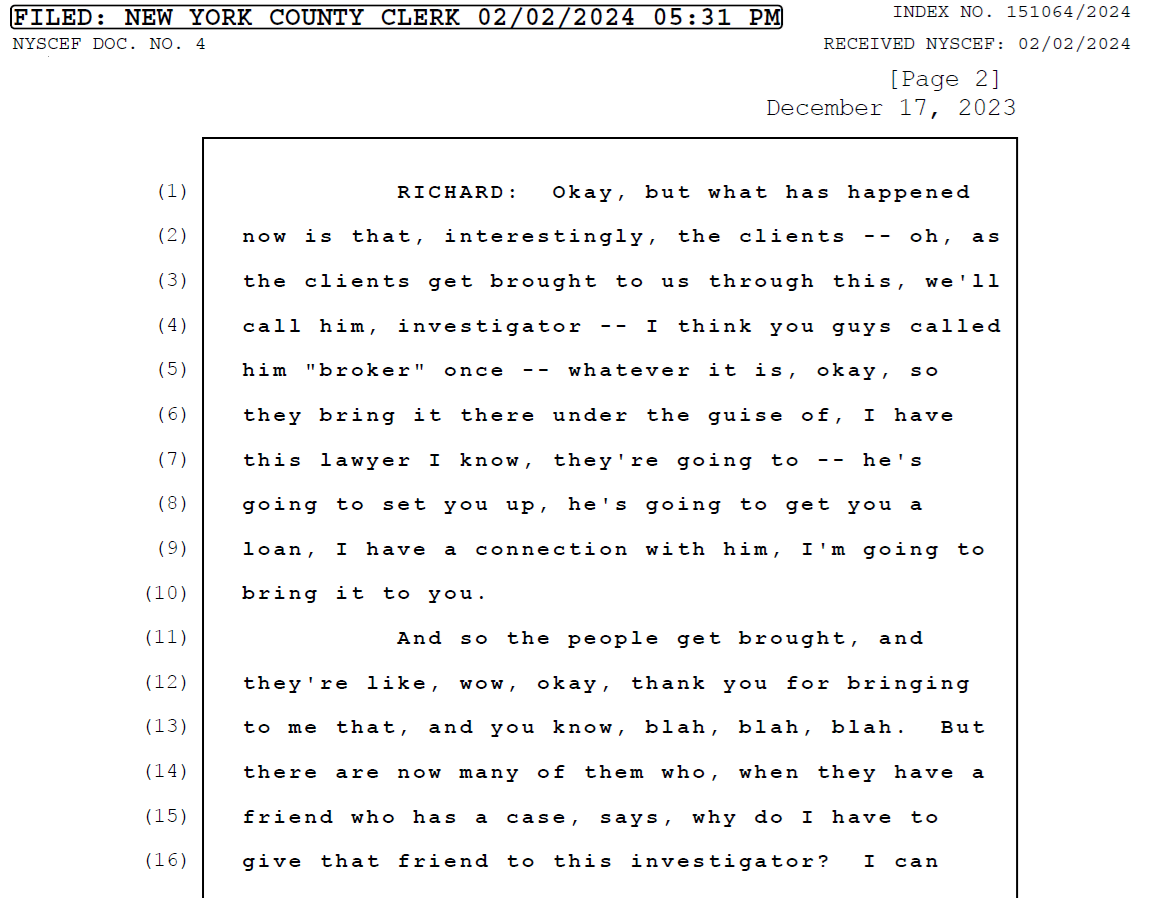
“It's just that -- we just want to come back with like, a scenario, and then as things progress, as you know, MRIs are positive, you know, the workers' comp is not controverted, you know, the next step is going to be the scope. It's going to be a possible fusion, and now I still don't think we want to get to these big chunks of funding.
I just like to give the client as little money as possible that he's happy and he's not going to leave you. Like that, you know, we want the client to be happy but not…”
-Quote from 2023-Hassett.K-00563 INDEX NO. 151064/2024
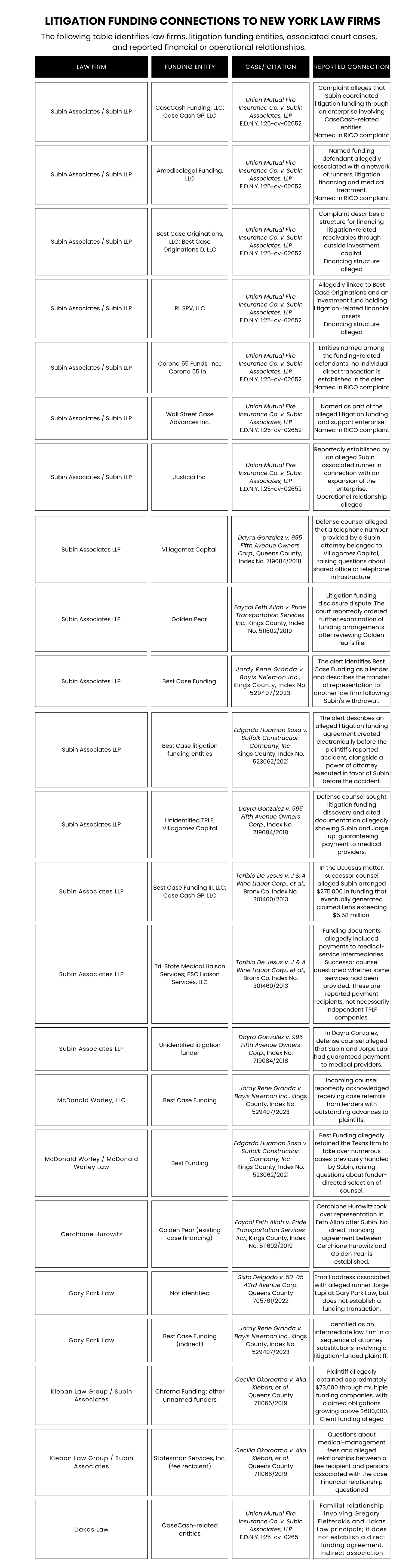
This table summarizes allegations and reported relationships appearing in publicly referenced litigation materials and the Fraudemic Alert series. The inclusion of any law firm, individual, or funding entity does not establish liability, misconduct, or an ethics violation. Allegations may be disputed, and the status of the referenced proceedings may have changed. Readers should consult the underlying court records for primary documentation and subsequent developments.
In 2019, Lesly Ortiz, a Dominican immigrant working as a hotel housekeeper in NYC, tripped on a Manhattan sidewalk. Hospital X-rays revealed no injuries, and she was discharged with ibuprofen. Shortly afterward, an acquaintance allegedly connected to a network of lawsuit runners referred her to the Subin law firm, which Ortiz said directed her to orthopedic surgeon Dr. Michael Gerling. Ortiz subsequently underwent spinal fusion surgery that she claims worsened her pain and impaired her ability to work. Her lawsuit later faced fraud allegations when defense attorneys accused Ortiz and 11 family members of participating in a fraudulent litigation scheme.
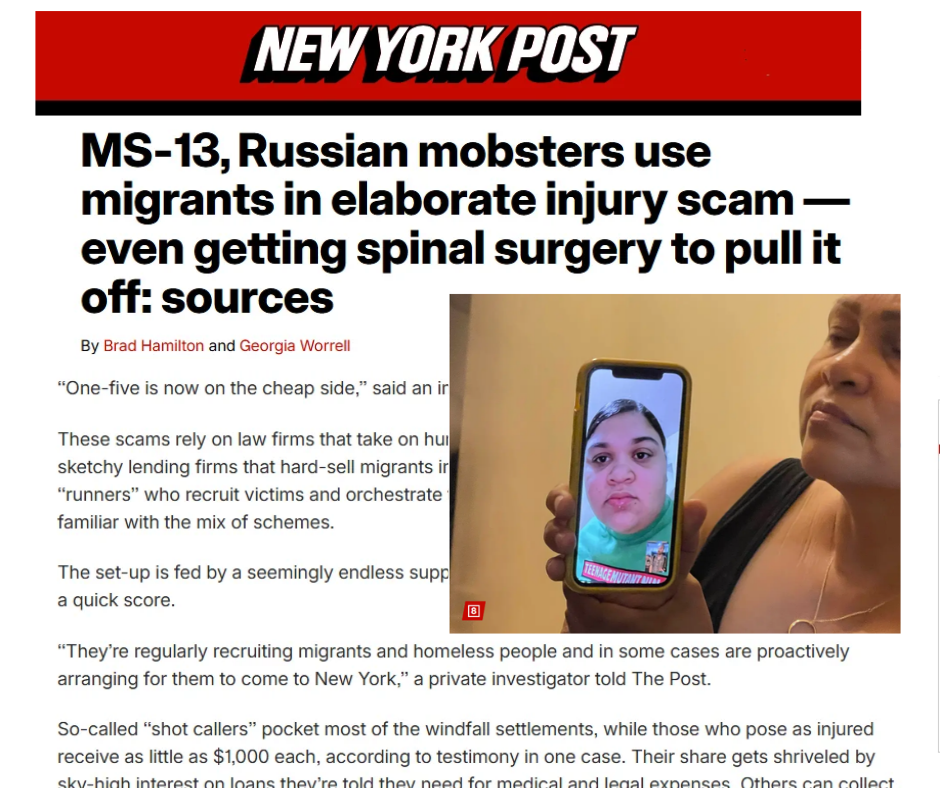
“The pain is unbearable since the operation on my lower back,” Lesly Ortiz told The Post. “I feel like a 60-year-old woman in the situation I find myself in. I don’t know how I will continue working.”
-Lesly Ortiz “MS-13, Russian mobsters use migrants in elaborate injury scam — even getting spinal surgery to pull it off: sources”. New York Post. June 16, 2024. and Ortiz v. Red Hook Deli and Grocery 2015 Corp. et al N.Y.E.D. 1:17-cv-07095